
What USP 800 means for your patients (and our staff)
USP <800> is the standard for handling hazardous drugs. It sounds like a back-of-house rule, but it affects your patients too.
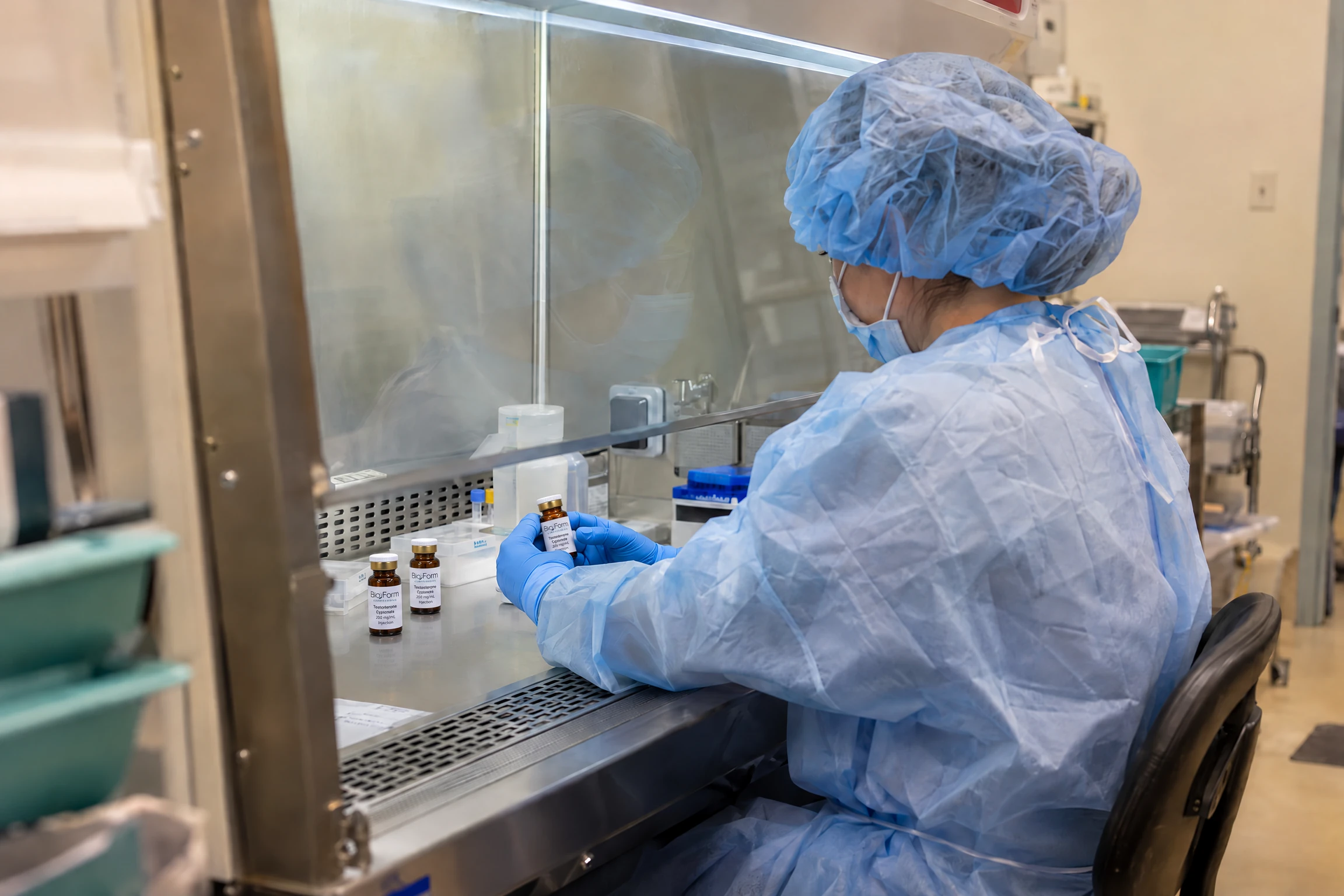
Why some hormones count as hazardous
The National Institute for Occupational Safety and Health (NIOSH) keeps a list of drugs that can be hazardous to the people who handle them. It includes some hormones, such as testosterone and estradiol, because repeated exposure carries reproductive risk. For a patient taking a prescribed dose, the medication is doing its job. For a pharmacy technician handling the raw ingredient every day, the exposure adds up.
USP <800> sets out how pharmacies must handle these drugs. It has been fully in effect since November 2023.
What it requires inside the pharmacy
- Containment. Hazardous drugs are compounded in a dedicated room kept at negative pressure, so air flows in rather than out, with an externally vented hood.
- Separation. Hazardous compounding is kept apart from everything else, which prevents trace hormone from ending up in an unrelated preparation.
- Protective equipment. Staff wear gowns and gloves tested for use with hazardous drugs.
- Cleaning and training. Surfaces are routinely deactivated and decontaminated, and staff are trained and reassessed.
What it means for patients
The most direct benefit is one patients never see: a preparation made in a pharmacy that follows <800> is protected from cross-contamination by other drugs. The standard also shapes labeling and counseling for medications patients handle at home:
- Wash hands after applying hormone creams or handling capsules.
- Prevent skin contact between treated areas and other people — especially children and anyone who is or may become pregnant.
- Store medication out of reach of children and pets.
- Ask the pharmacy how to dispose of unused medication and used needles.
What it means for prescribers
If your patients receive compounded hormones, it is reasonable to ask the pharmacy how it handles hazardous drugs and whether it has a dedicated containment room. Reinforcing safe-handling instructions at the point of prescribing — particularly around transference from creams — helps protect the people your patients live with.
BioForm compounds hazardous drugs in a dedicated negative-pressure containment room, separate from our non-sterile and sterile rooms. See quality & compliance for more.
Educational information for healthcare professionals and practice staff. Not medical or legal advice. Compounded medications are not FDA-approved.